
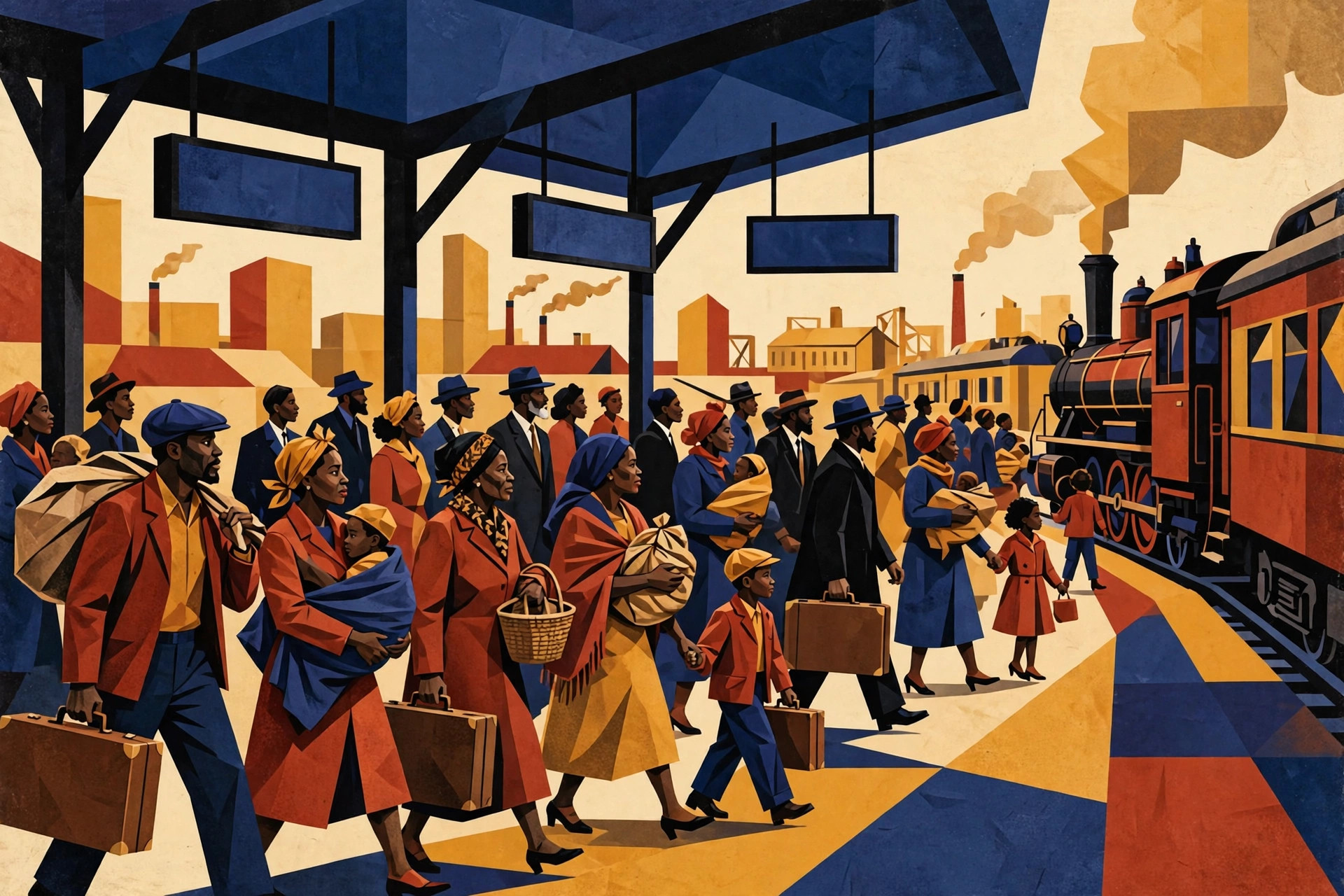
History painting used to mean size. Big canvas, big heroes, one frozen moment blown up until it filled a wall.
Jacob Lawrence did the opposite. In 1940–41 he took the Great Migration — the movement of more than a million Black Americans from the rural South to the industrial North after the outbreak of the First World War — and broke it into 60 panels, each just 12 by 18 inches, painted in casein tempera on hardboard. Each panel carries a short caption written by Lawrence himself. MoMA, which owns half the series, calls the result a landmark and a key example of how history painting was radically reimagined in the modern era. Small, here, is not modest. Small is the method.
The captions came first
Lawrence wrote the story before he painted it.
Before painting the series, he researched the subject and wrote captions to accompany each panel, working — in the Phillips Collection’s phrase — like the storyboards of a film. The Whitney’s account adds that his research drew on the Schomburg Collection in Harlem, and that Gwendolyn Knight prepared the gessoed panels and helped with the captions. Knight and Lawrence married in 1941, the year the series was completed.
That order matters. Image-makers usually get handed words at the end, as labels. Lawrence built the whole work out of the pairing: one sentence, one scene, sixty times, neither half complete without the other. You cannot hide behind one gorgeous frame when frame 41 has to carry its own fact.
He had rehearsed the format for three years. Before the Migration came narrative series on Toussaint L’Ouverture (1938), Frederick Douglass (1939) and Harriet Tubman (1940). The Migration Series is what happened when that method met a subject too large for one life: a people’s movement, told without a single protagonist.
Sixty panels, painted all at once
Lawrence did not finish panel 1, then start panel 2.
He applied a given colour across every panel in succession, starting with the darkest black and working toward the lighter values, using hand-mixed casein tempera after preparatory drawings and gesso-primed hardboards. An odd way to work, until you see the point: unity. Sixty little pictures had to read as one work, and a colour mixed fresh each day would have drifted.
The images are pared down to the bone. Angular figures. Flat blocks of colour. No sentimentality in the faces. Certain shapes keep returning until they become punctuation: the train, the station, ladders, stairs, windows, crowds carrying bags. Movement itself gets a visual grammar.
He does not tidy the story up
This is where the series earns its place in criticism, not just in survey books. Lawrence tells a story of leaving in search of greater economic, social and political freedom — and he refuses to let the North off the hook.
The Phillips summary is blunt about the range: from lynching in the South to the bombing of Black homes in the North. Between those poles sit overcrowded stations, letters home reporting better conditions, families around a table deciding whether to go at all. Panel 58 notes that in the North Black people had better educational facilities. Panel 60 closes it with five words: “And the migrants kept coming.”
No arrival scene. No resolution. The last panel is a present tense, not a full stop — a critical choice, not an unfinished one. Migration, in Lawrence’s telling, is not an event that happened once. It is an ongoing condition of American life, still in motion as you look at it.
Lawrence knew that condition from inside his own family. Born in Atlantic City in 1917, the son of Southern migrants, he moved with his mother and sister to Harlem in 1930, aged 13, and found art through community workshops there, encouraged by teachers including Charles Alston. He grew up inside its second chapter.
Two museums, half a work each
The series was published in Fortune magazine in November 1941, shown at Edith Halpert’s Downtown Gallery in New York, and jointly bought in 1942 — the Phillips Collection taking the odd-numbered panels, MoMA the even-numbered ones. Lawrence, 24 by then, had national acclaim for a work he later called the creative highlight of his career.
Sit with that split for a second. A work conceived as one unit, written as one text, painted in one pass of colour, now physically lives in two cities. It only exists whole when the two museums lend to each other. MoMA’s 2015 exhibition One-Way Ticket reunited all 60 panels there for the first time in 20 years, and the Phillips did the same in 2016. Most days, you are looking at half a history, knowing the missing half is a train ride away. For a series about people separated by distance and holding together anyway, that accident of ownership fits almost too well.
Why I keep coming back to it
I split my own time between Rotterdam and New York, and I am rebuilding this site by hand while studying design — so a work about movement between places, built panel by panel out of a written plan, was never going to leave me alone for long.
Its lesson is a working one. Constraint is not the enemy of scale here; it is how scale gets built. Sixty small, cheap, same-sized boards. One palette, disciplined across all of them. Words written first, images made to answer them. Lawrence was 23, with no large canvas and no large budget, and he produced the defining visual account of the Great Migration anyway.
Plenty of history painting asks you to admire it. Lawrence’s asks you to read it — panel by panel, caption by caption, in order.
Sources
- One-Way Ticket: Jacob Lawrence’s Migration Series and Other Visions of the Great Movement North — MoMA
- Jacob Lawrence’s famed Migration Series to reunite at The Phillips Collection — The Phillips Collection
- Jacob Lawrence: The Migration Series, Panel 30 — The Phillips Collection
- Jacob Lawrence: Exploring Stories — Whitney Museum of American Art