
Listen to this article
Take the story with you. Choose a voice and a pace that suits you.
Or listen in another language / choose a voice
Getting your device voices ready…
The voice follows the displayed language and your browser’s regional preference when available. You can choose another narration voice.
Biophilic design in small apartments usually starts — and stops — with a plant. One pothos on a shelf. Job done, apparently. Except the man who built this field spent a whole essay warning against exactly that move. A single bit of nature dropped into a room that fights it in every other way, he argued, does almost nothing for the people living there.
Small flats cannot afford almost nothing. So the question is stricter: what survives once you remove the showroom greenery and keep only what works at 40 square metres?
What is biophilic design, in Kellert’s sense
Ask what is biophilic design and the honest answer starts with biology, not styling. The biologist E. O. Wilson popularised the word biophilia in his 1984 book of that name, arguing that people carry an innate tendency to seek connection with living things. Stephen Kellert, a Yale social ecologist, turned that hunch into a design discipline.
His test was demanding. In his 2015 essay for Metropolis, Kellert pointed out that our species evolved for more than 99 percent of its history in response to the natural world, and now spends roughly 90 percent of its time inside built environments. Good design means making good habitat. Not decorating a box.
Three of his conditions matter most in a small home. Contact has to be repeated and sustained, part of daily life. The elements have to reinforce each other as one setting, not isolated gestures. And it has to attach you to the place — people look after rooms they feel something for.
A lone plant fails all three. Daylight, air, wood under your hand, a seat by the window you actually use every morning? That starts to pass.
The 14 patterns of biophilic design, shrunk to flat size
The most usable toolkit came in 2014, when William Browning, Catherine Ryan and Joseph Clancy at Terrapin Bright Green published the 14 patterns of biophilic design, distilled from more than 500 studies. Fourteen sounds like a lot for a studio flat. Read them as three groups and the list calms down.
Nature in the space is the direct stuff: visual connection with nature, moving air, water, light that changes through the day, contact with seasonal change. Natural analogues are the indirect version — wood, stone and cork, organic curves, patterns with the kind of ordered complexity you find in a leaf or a shell. Nature of the space is about shape: prospect, meaning a long view out; refuge, a sheltered corner at your back; mystery, a glimpse that pulls you around a corner.
A flat cannot hold all fourteen. But notice what the groups expose: plants cover maybe two patterns. Light, view and refuge — the ones with the strongest evidence — cost no floor space at all.
That evidence has an old anchor. In 1984 Roger Ulrich reported in Science that hospital patients whose windows faced trees had shorter post-operative stays than matched patients facing a brick wall, a study the Arch2O guide to biophilic interiors still puts first in line. The window did the work. Not a picture of a window.
What biophilic design in small apartments actually asks for
Start where the evidence starts: with the glass.
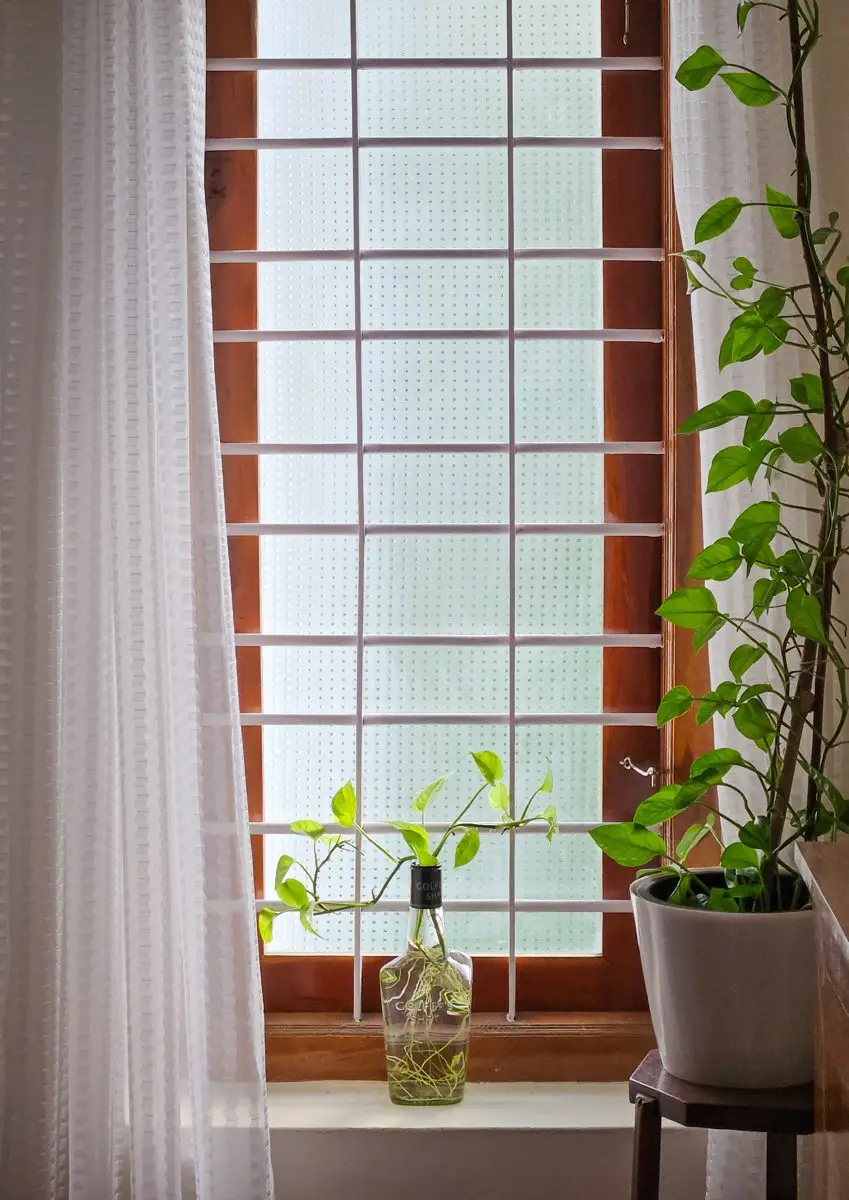
Keep the window clear and make it a destination. A low seat, a cushion, the chair you read in turned toward the light — that one move buys visual connection, daylight that shifts through the day, and prospect in a single square metre. Heavy curtains that stay shut until noon cancel all three before breakfast.
Then give the room one refuge. Terrapin pairs prospect with its opposite on purpose: people settle where they can see out without feeling exposed. In a studio that can be a high-backed chair in a corner, a shelf behind a reading seat, a pendant lowered over a table. Cheap geometry. It changes how long you can stand to sit in the room.
Air counts, too. A window that opens — and gets opened — delivers airflow variability, plus the small non-rhythmic surprises the patterns prize: leaves moving, shadows sliding across a wall. A sealed flat with perfect climate control scores worse here than a slightly draughty one.
Biophilic interior design ideas that earn their floor space
Once light, view and refuge are sorted, objects get their turn. Choose biophilic interior design ideas that stack patterns instead of buying them one by one.
Materials first. A solid wood table, a cork board, linen and wool where your hands land — that is material connection, biomorphic pattern in the grain, and complexity and order, three patterns riding on furniture you needed anyway. Plastic printed with a leaf motif manages none of them; Kellert’s condition about real human adaptation is brutal on fakes.
Plants come last, and they go vertical. A trailing plant on a high shelf, one tall plant beside the window where the light already is, herbs on the sill you open daily. Vertical planting keeps the visual connection alive without eating the floor, and tending them supplies the repeated, sustained engagement Kellert insisted on. Watering is not maintenance here. It is the mechanism.
Skip the tabletop fountain. In a small flat, water features bring humidity, noise and upkeep out of all proportion to their size — the Arch2O guide flags the same maintenance problem. A view of rain on the glass does the pattern’s job for free.
A short order of operations
If I were sequencing this on a tight budget — and studying design partway through an MFA at Falmouth, begun in September 2023, has mostly taught me sequencing — it would go like this. Free the window this week. Build the refuge this month. Swap one synthetic surface for a natural material when it needs replacing anyway. Add plants only into light you have already fixed.
That order is the whole argument. Habitat first, ornaments last. The plant in the corner can stay — it just has to stop working alone.
Sources:
- Terrapin Bright Green — 14 Patterns of Biophilic Design
- Stephen Kellert — What Is and Is Not Biophilic Design
- Arch2O — Biophilic Interior Design: Principles, 14 Patterns, Examples
Photo via the WordPress Photo Directory, released under CC0.