
Listen to this article
Take the story with you. Choose a voice and a pace that suits you.
Or listen in another language / choose a voice
Getting your device voices ready…
The voice follows the displayed language and your browser’s regional preference when available. You can choose another narration voice.
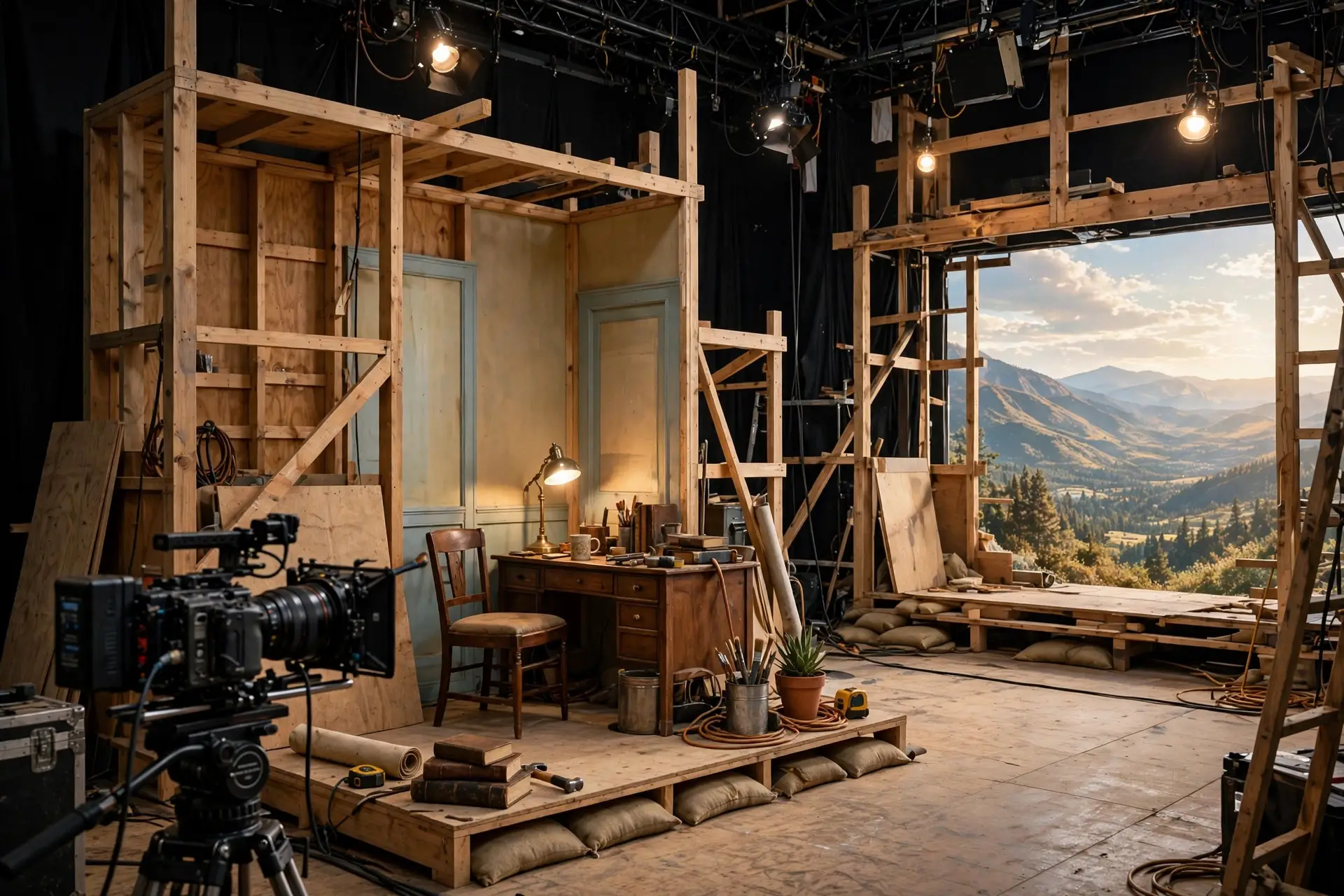
Practical sets vs CGI gets framed as a loyalty test. Pick a side. Defend it online. The films people actually rewatch rarely picked a side at all — they built what an actor could touch, lit it properly, and saved the computer for what plywood cannot do.
That is not nostalgia. It is a production decision with a visible result, and it shows up in the work whether the budget is enormous or embarrassingly small.
Practical sets vs CGI is a false choice
Look at the hybrid record. Jurassic Park (1993) used roughly six minutes of CGI in the whole film, according to the Pixflow analysis of practical effects and CGI, and paired that restraint with Stan Winston’s full-scale animatronics. Thirty years on, the dinosaurs still land. Mad Max: Fury Road (2015) ran more than 150 real vehicles and real stunt work, then used digital tools to extend skies, clean safety rigs and widen the world. The digital layer holds because there is a physical layer underneath it.
Contrast tells the same story from the other end. The fully digital Scorpion King in The Mummy Returns (2001) is still trotted out as a warning, not because the artists lacked skill, but because there was nothing real for light, weight or an actor’s eye-line to agree on. Our brains are good at this detection job. We have spent our whole lives watching how light hits a surface and how heavy things move. A set obeys those rules for free. A render has to fake every one of them, shot by shot.
None of this makes CGI the villain. It makes it a second step.
Practical effects vs CGI, and why one ages slower
Practical effects vs CGI is partly an ageing question. A puppet, a miniature, a rotating hallway — photographed once, they look the same on a phone screen or a 4K television because they were there, under real light, casting real shadows. Digital work ages at the speed of its tools. Rendering improves, displays sharpen, and yesterday’s convincing surface starts to look smooth in the wrong places.
That is why John Carpenter’s The Thing (1982) and Ridley Scott’s Alien (1979) still play as physical threats, and why Christopher Nolan keeps choosing the expensive-looking practical route that often turns out to be the controlled one. For Inception (2010) he built a rotating corridor and let the actors fight inside it. For Oppenheimer (2023), as Pixflow notes, he said computer graphics “tends to feel safe” and recreated the Trinity test with pyrotechnics, forced perspective and IMAX cameras instead. Safe was the problem. The scene needed danger you could feel in your chest.
Restraint is the other half. Terminator 2 (1991) still works because its signature effect is a reflective chrome surface — a simple idea, cleanly executed — not a digital attempt at skin, fur and weather all at once.
How production designers build film sets, step by step
So how production designers build film sets explains why the practical part cannot be bolted on late. The process starts with the script, months before anyone picks up a hammer.
HowStuffWorks’ breakdown of film set construction puts the production designer near the front of the queue: reading scene descriptions, costing what to build, and flagging the places where a digital effect would be cheaper than a full build. That early call — build, find, or render — shapes everything else.
Then comes research, colour and texture decisions with the director and cinematographer, and concept drawings or models for each set. Once those are approved, the art director’s drafters turn them into detailed blueprints, and a construction team of carpenters, painters, plasterers, riggers and scenic artists builds the thing. Set decoration follows: furniture, fittings and props that tell you who lives here before anyone speaks.
Notice where CGI sits in that chain. It is contracted alongside the build, to supplement the constructed set — a matte painting here, an extension there — not to rescue a set that was never designed.
Production design on a budget: spend on what the camera touches
You do not need Nolan’s resources to use his order of operations. Production design on a budget works the same way, just with harder choices about where the real thing matters most.
StudioBinder’s production design tips start with location, for a blunt reason: a real room you can shoot in for little or nothing already has walls, texture and history that a cheap build will struggle to match. Sarah Greenwood famously turned a single theatre into dozens of sets for Anna Karenina (2012) instead of chasing locations across a continent.
Next, protect the hero pieces. Spend on the props and surfaces that get close-ups, the chair an actor grips, the door they slam. Let the background fall off. StudioBinder repeats a line set people pass around for a reason: stage design is about 75 percent lighting. A modest set lit with intent looks expensive. A costly set lit flat looks like a showroom, then a waiting room.
A mood board sounds soft until you watch a crew waste a day because three people imagined three different rooms. Pin the reference down early. It costs nothing and it stops the expensive kind of wandering.
My own sequencing, partway through an MFA in Design and Visual Communications at Falmouth that I began in September 2023, has settled into something plain: decide what must be real, build or find that first, and only then ask digital tools to stretch it. Rebuilding my own site by hand taught me a version of the same lesson — a real structure underneath makes every later layer easier to trust.
Build it real where hands, light and eyes meet it. Extend it where they don’t. That split is the whole craft.
Sources:
- Pixflow — Practical Effects vs CGI: Which Ages Better?
- HowStuffWorks — Planning Film Set Construction
- StudioBinder — 10 Production Design Tips For Filmmakers on a Budget