
Listen to this article
Take the story with you. Choose a voice and a pace that suits you.
Or listen in another language / choose a voice
Getting your device voices ready…
The voice follows the displayed language and your browser’s regional preference when available. You can choose another narration voice.
Benin Bronzes restitution stopped being a thought experiment a while ago. Crates have crossed oceans; ownership papers have been signed in Lagos, Berlin and Washington. What remains unsettled is narrower: who receives them, where they will live, and what happens to the museum holding the most, which has returned none.
What are the Benin Bronzes? An archive that hung on pillars
Ask what are the Benin Bronzes and the first surprise is the name: most are not bronze. Britannica’s entry on the Benin Bronzes describes thousands of works made mainly from brass, alongside carved ivory, wood, leather and bone, produced from the 15th to the 19th century by guilds working for the oba, the king, in Benin City, capital of the Kingdom of Benin in present-day Nigeria. Not the modern country of Benin.
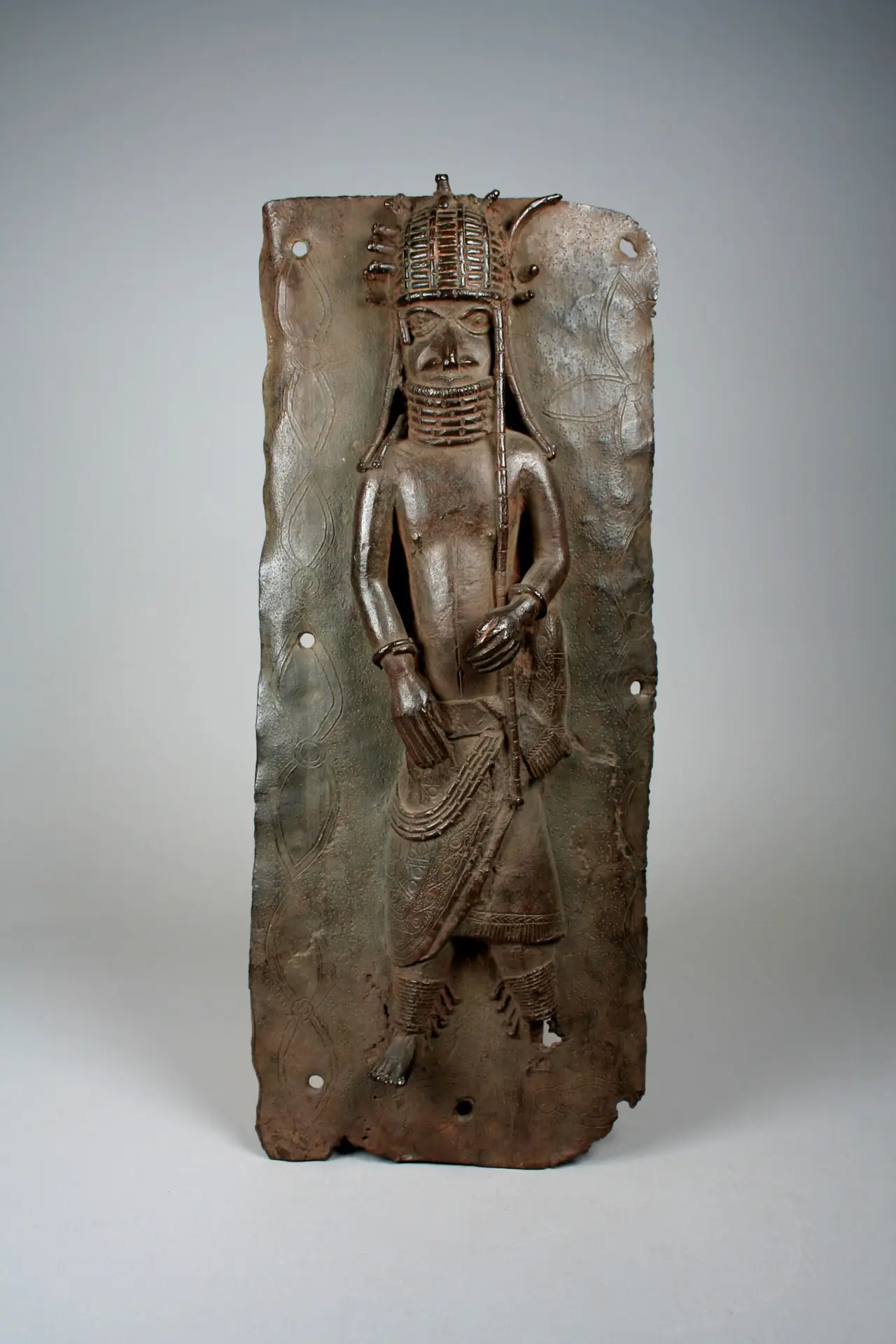
The best-known pieces are the palace plaques: brass reliefs cast by the lost-wax method and fixed to the pillars of the royal palace. They were not decoration in the way a hotel lobby means decoration. They recorded battles, ceremonies and court hierarchy — a state archive in metal. The commemorative heads are quieter: idealised brass heads for the altars each new oba built to his predecessor, topped with ivory tusks carved with a reign’s events. Archive, altar, regalia: the looting was not theft of valuables. It was the removal of a kingdom’s records in a single operation.
Benin Bronzes restitution starts in February 1897
Benin Bronzes restitution starts with a date, not a signing ceremony in the 2020s. In January 1897, acting consul-general James Phillips set out for Benin City against Oba Ovonramwen’s request to postpone until after the Ague festival. His party was ambushed on the way; Phillips and most of his men were killed. London answered with the Punitive Expedition. Over three weeks in February 1897, British forces burned towns, captured the city and exiled Ovonramwen to Calabar. Then they looted the palace.
Thousands of objects were shipped to London, handed out among members of the expedition or sold to offset the cost of the invasion itself — the kingdom’s art, auctioned to pay the army that had seized it. The British Museum’s own account of its Benin Bronzes records that it displayed 304 plaques on loan in the autumn of 1897 and petitioned successfully to keep 203. The rest scattered through dealers and museums worldwide. The Digital Benin database now traces 5,246 objects across 131 institutions in 20 countries, per Hyperallergic.
Benin Bronzes returned to Nigeria: a trickle, then a run of signatures
Demands for Benin Bronzes returned to Nigeria are not a recent mood. Oba Akenzua II, Ovonramwen’s grandson, made the first formal request to the British Museum in the mid-1930s and got almost nowhere — a couple of pieces, including his grandfather’s coral regalia, in 1938. For decades the defences held: later purchases had been legal, and the objects were safer in the North. That second argument aged badly. When the British Museum announced in 2023 that a veteran curator had stolen more than 1,500 items from its own stores, Nigeria’s museums chief Abba Isa Tijani pointed out the irony of the security lecture.
The break came from politics, not from inside the museums. Macron’s 2017 speech in Ouagadougou promised returns of African heritage within five years; the Sarr–Savoy report that followed recommended permanent restitution. Germany signed over ownership of more than 1,100 Benin objects in 2022. The Smithsonian transferred 29 the same year; London’s Horniman Museum handed over 72. Then, in June 2025, the Netherlands returned 119 bronzes in Lagos — Artnet’s account of the recent returns calls it the largest restitution of its kind — and a week later Boston’s Museum of Fine Arts transferred two more.
Read those two handovers side by side and you hit the live question. The Dutch bronzes went to the Nigerian government. Boston’s went directly to Oba Ewuare II, whose great-great-grandfather was on the throne in 1897. A 2023 Nigerian declaration recognised the oba as rightful owner of returned bronzes, and by 2025 he had put the National Commission for Museums and Monuments in charge of recovering and housing them. Restitution does not end an argument about ownership. It relocates it — to the country the objects came from, which is where the argument belongs.
British Museum Benin Bronzes: the holdout
Which leaves Bloomsbury. The British Museum Benin Bronzes collection is the largest anywhere: more than 900 objects. The museum has returned none. Its stated position is legal, not moral — the British Museum Act 1963 bars its trustees from permanently giving away collection objects — and it points to its dialogue with the Royal Palace and Nigerian museums.
That position gets lonelier every year. A museum label is a piece of art criticism whether it wants to be or not. A plaque described as a masterpiece of Edo casting, full stop, tells one story. The same plaque with 1897 in the second sentence tells a truer one. The returns have rewritten labels everywhere else — and the objects coming back to Benin City, where a new Museum of West African Art designed by David Adjaye awaits them, will be read in the place they were made to be read in.
Studying for an MFA in Design and Visual Communications at Falmouth, which I began in September 2023, the bronzes teach one discipline: read the object, then read how it got to you. Provenance is not paperwork attached to art history. Half the time, it is the art history. From where I live in the Netherlands, the Dutch handover made that a fact of the present tense, not a seminar point.
The plaques were made to keep a kingdom’s memory. For a century they did that job in the wrong cities, under labels that skipped the violent paragraph. Slowly — crate by crate — the memory is going home.
Plaque with Warrior Chief, brass, c. 1540–70, Court of Benin. Photo: The Metropolitan Museum of Art, via Open Access (CC0)
Sources:
- Encyclopaedia Britannica — Benin Bronzes
- British Museum — Benin Bronzes
- Artnet News — Why the Benin Bronzes Are Being Returned — and Who Gets Them
- Hyperallergic — New Online Database Tracks the Whereabouts of the Benin Bronzes