
Listen to this article
Take the story with you. Choose a voice and a pace that suits you.
Or listen in another language / choose a voice
Getting your device voices ready…
The voice follows the displayed language and your browser’s regional preference when available. You can choose another narration voice.
Most designers price their first freelance jobs by copying someone else. A friend charges this. A forum says that. The client sounds keen, so you shave a bit off to be safe.
Then the calls, exports and extra round nobody mentioned eat the fee. Learning how to price freelance design work fixes that at the source: build a floor from your own numbers first, then decide how a job should be quoted.
Start with how to price freelance design work: know your floor
Your floor is simple arithmetic, even if the answer stings a little.
Take the income you need for the year. Add your business costs — software, equipment, insurance, accounting, the lot. Divide by the days you can honestly bill.
That last number is where most people cheat. After holidays and sick days you might have around 220 working days left. Take out admin, pitching, chasing invoices and quiet weeks, and most freelancers bill far fewer. Skilful Designers puts realistic billable days at 130 to 165. Their worked example is plain: £45,000 of income plus £4,000 of costs, divided by 155 billable days, gives a floor of about £315 a day.
Do your own version. Write it down. If a quote falls below that floor, you are not being competitive. You are subsidising the client.
Count every working day as billable and every rate looks generous — until the quiet weeks arrive.
Your freelance designer day rate needs a definition
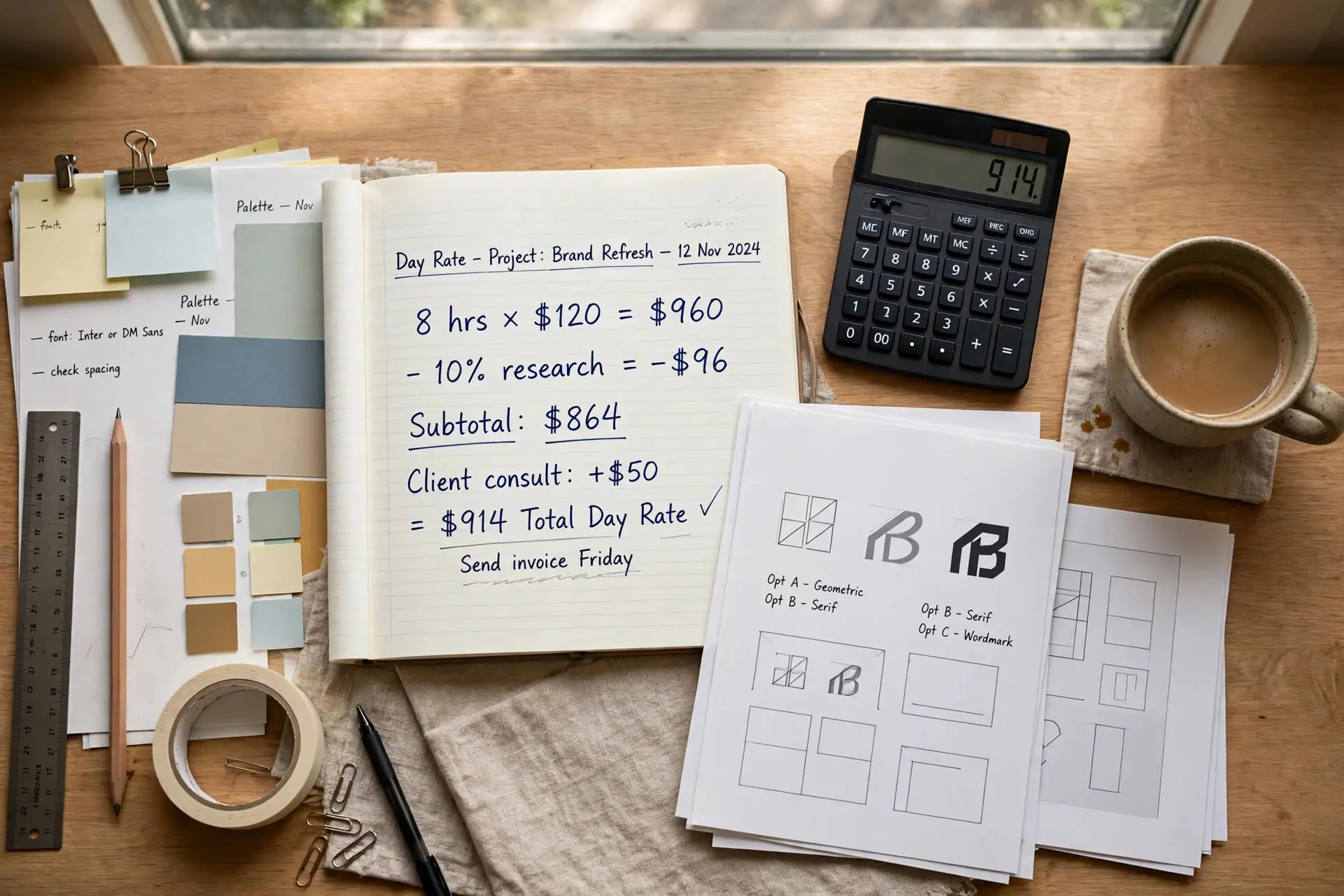
A freelance designer day rate only works if both sides mean the same thing by a day.
Is a day eight hours? Seven and a half? Does it include prep calls and a follow-up summary, or just the hours in the room? JobWhip’s guide to day and hourly pricing makes the point bluntly: a day rate is only as good as the hourly rate underneath it and the number of hours a day is agreed to mean.
Long days show why. Quote twelve days, watch the client’s days stretch to nine and a half hours, and your effective rate drops without anyone renegotiating. You never defined it.
Put it in the agreement: a day is eight hours, time beyond that billed hourly or in half-day blocks. Track your hours even when billing by the day. Decide half-day and weekly figures in advance too — a half-day booking often wrecks the rest of that day, so charging exactly half can underpay you.
Fixed price vs day rate for designers: pick by the job
The fixed price vs day rate for designers question has no single right answer. It depends on what the client is actually buying.
Charge by the day when the work is open-ended: covering for an in-house designer, joining a sprint, running a workshop, staying embedded with a team while tasks change week to week. The client is buying your availability. A day rate fits.
Quote a fixed price when the deliverables are clear: a logo, a website design, a packaging set. Estimate the days from your floor, add contingency for the unknowns, and quote one figure for a listed set of outputs. If you work efficiently, you keep the difference. If the scope is vague, that same fixed price will eat you alive — so the list matters more than the number.
Hourly still fits small, irregular pieces: a few edits, a quick review. Most client work lands better as a fixed quote built from a day rate the client never has to see.
Where value based pricing for designers actually fits
Value based pricing for designers is not a trick to charge more for the same hours. It fits a narrower set of jobs: work with a large, clear payoff for the client.
A rebrand ahead of a funding round. Packaging for a national retail launch. The price reflects what the result is worth, not how long it took. Skilful Designers calls this the main route above a day-rate ceiling — it needs a real conversation about goals first. Skip it when the payoff is fuzzy; if you cannot name the value in the client’s terms, go back to your day-rate maths.
Protect the price after you quote it
A good rate can still lose money in the small print.
List every deliverable and file format in the quote. Anything not listed is extra. Limit revisions — two rounds is common — and state that further rounds are charged at your day or hourly rate.
Take a deposit. For smaller jobs, 50% before work starts is normal practice. For bigger ones, split it: deposit, a payment on concept approval, then the balance before final files are released. Send low-resolution or watermarked proofs for approval, and hand over masters on payment.
Watch the quiet mistakes. Dividing a salary by 260 makes freelance life look cheap: a £40,000 salary is about £154 a working day, but matching it freelance takes roughly £246 a day. Hidden hours add 15 to 25% to a job if you let them vanish.
If a client pushes on price, shrink the scope, not the rate. The first price sets expectations for every job after it. Raise rates yearly, in writing, a month or two ahead, for new projects only.
Your rate is not a personality test. It is a business number, built from income, costs and days you can actually bill. Get that number right, define your day, match the pricing model to the job, and most quoting conversations stop feeling like a negotiation about your worth. They become what they should have been all along: a clear offer, for clear work, at a price that lets you keep doing it.
Sources
- Skilful Designers — How to Price Freelance Design Work
- JobWhip — Day Rate or Hourly Rate? Pricing Freelance Work Both Ways
- FreelanceNumbers — Freelance Day Rate: How to Calculate, Set, and Charge a Daily Rate