
Art, representation & media literacy
What the Four Continents and the femme fatale can teach us about looking beyond stereotypes.
A beautiful image can carry an ugly assumption. A figure may appear elegant, mysterious, powerful, or desirable while the story around her reduces an entire group of people to a single idea. Learning to recognize that reduction is an essential part of media literacy.
The female personifications of the Four Continents and the femme fatale offer two ways to examine this problem. They belong to different artistic traditions. Reading them alongside one another can nevertheless help us ask a shared question: who gets to be a person, and who is made to stand for someone else’s fears or fantasies?
The Four Continents: a worldview made visible
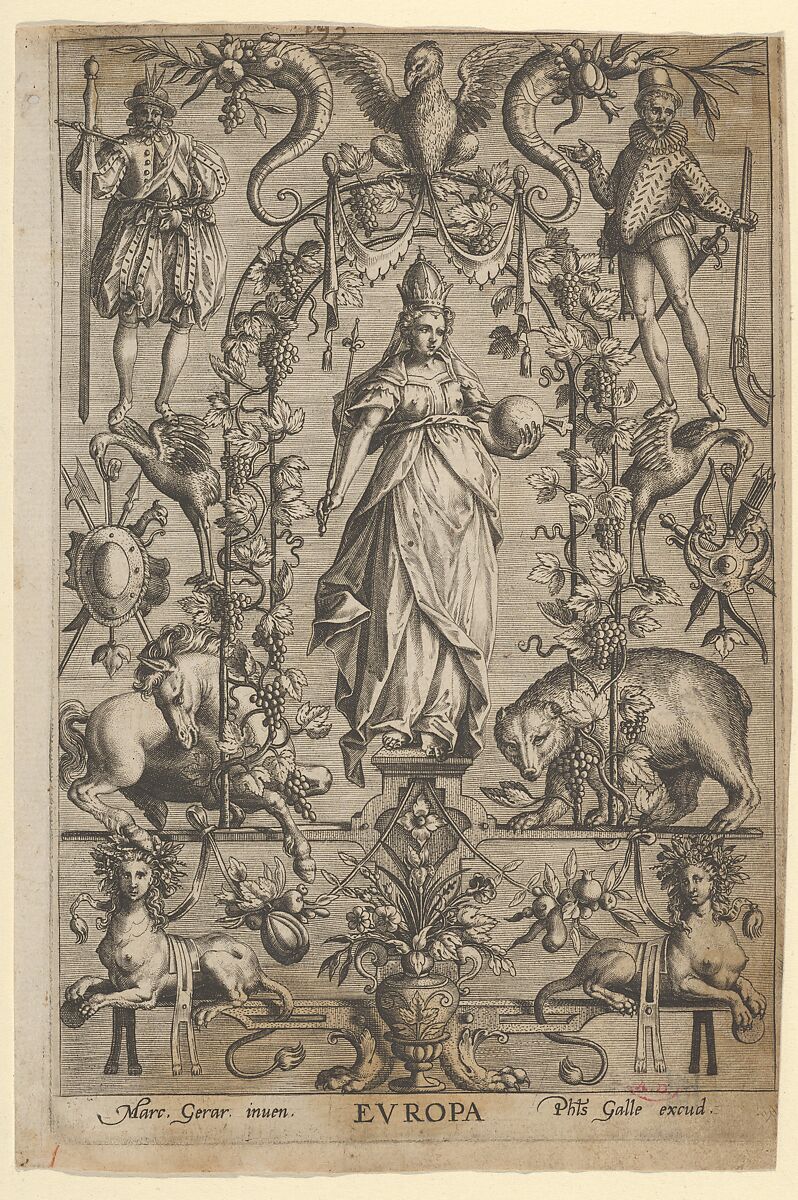
European artists used female figures to personify Europe, Asia, Africa, and America long before the twentieth century. The tradition developed through Renaissance and early modern art and appeared in prints, maps, and decorative objects. These images reflected European ideas about the world, shaped by colonial expansion, trade, religion, and unequal power. They were not neutral portraits of the people who lived on those continents. The Met’s historical overview explains this context.
It is important to distinguish personification from observation. A continent cannot have one personality, one appearance, or one way of life. When an artist turns it into a single woman surrounded by selected objects, that selection tells us something about the artist’s culture and audience—not an essential truth about millions of people.
Look at what the symbols are doing
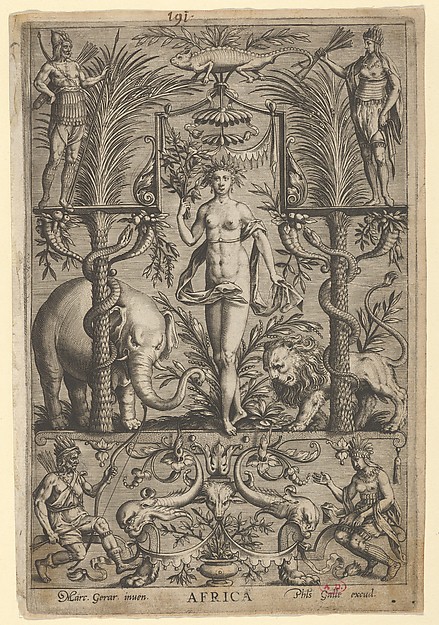
In the engraving above, Europe wears a crown and carries a scepter and orb. The Met identifies these as signs of royal authority. In the companion image, Africa is surrounded by palms, an elephant, and a lion. Its central figure is unclothed, while Europe is dressed as a queen. Those differences are choices, and they invite a comparison between political power and an imagined abundance of land and wildlife.
My reading is that such a contrast can make hierarchy feel natural. One figure is presented through the language of rule; another through the things a distant viewer might desire, fear, or exploit. Recognizing that framing does not mean dismissing the artist’s skill. It means refusing to let visual skill make the assumptions invisible.
Nor should we treat every continent allegory as identical. The symbols and compositions changed across artists and periods. A responsible critique begins with the particular image in front of us, then considers the broader tradition.
The femme fatale: a different tradition, a related question
The femme fatale is a figure associated with seduction, danger, and deception, familiar from film noir. She is not another name for the female personifications of the continents. The connection I am drawing here is an interpretive one: both can turn women into symbols through which other people’s anxieties are expressed.
Even within noir, that figure is more complicated than a simple warning about women. The BFI’s discussion of Out of the Past examines how films can question a male protagonist’s tendency to blame fate or a woman for his predicament. Read the BFI analysis.
That distinction matters. A woman can be ambitious, angry, seductive, independent, or morally flawed without her character being a stereotype. The problem emerges when those traits become shortcuts for a gender, race, or culture, and the character is given little life beyond them.
Recognizing the pattern in present-day media
When watching a film, reading a novel, or looking at an advertisement, we can ask whether someone is allowed an inner life. Does the character have goals unrelated to the protagonist? Do we understand her choices? Can she surprise us, or is every scene designed to confirm the same familiar label?
Calling an Asian woman “mysterious,” portraying a Black woman only through aggression or sexuality, or treating a woman’s independence as a threat deserves scrutiny. These are reductive frames, not descriptions of the people concerned. A critique should identify how a specific work uses them rather than simply replacing one sweeping generalization with another.
Context also changes the reading. Who tells the story? Whose perspective does the camera follow? Does the work endorse a prejudice, expose it, or leave that tension unresolved? Counting appearances alone cannot answer those questions.
Media literacy is a practice
The National Association for Media Literacy Education describes media literacy as involving access, analysis, evaluation, creation, and action across forms of communication. It asks us to be thoughtful makers as well as thoughtful audiences. Explore NAMLE’s definition.
Five questions to bring to the next image or story:
- Who made it, and for whom? Consider the creator, commissioner, audience, and purpose.
- Which details carry the message? Look at clothing, posture, lighting, objects, dialogue, and framing.
- Who has agency? Notice who makes decisions and whose experience remains unexplored.
- What is missing? Seek perspectives from the communities being represented.
- How could it be told differently? Imagine a change that gives the person greater specificity, complexity, or control.
Making room for fuller stories
More inclusive representation does not require flawless characters or art without conflict. It requires room for people to be particular: contradictory, funny, capable, vulnerable, and more than a symbol for an entire community.
By examining inherited images carefully and listening to the people whose lives they claim to describe, we can become more responsible viewers and creators. The aim is to expand the stories we recognize—and the humanity we allow within them.
Join the conversation: Have you revisited an image or film and noticed a stereotype you had previously overlooked? What changed the way you saw it?
Sources & image credits
Historical context: Freyda Spira, “Allegories of the Four Continents”, The Metropolitan Museum of Art (2021). Artwork details and individual credits are linked beneath each image. Film discussion: BFI / Sight and Sound, “Home of the weak: Out of the Past and four ways of framing film noir.” Media literacy: NAMLE.
Both artwork images are designated public domain by The Met and made available under its Open Access / CC0 policy. No royalty payment is required. Their inclusion supports critical discussion of historical representation.